
MSCA Doctoral Researcher (Develop methods to assess the brain state spatiotemporal interference stim
- Sijainti Pirkanmaa
Julkaistu 22.01.2026, 12:00 - Haku päättyy 01.03.2026, 23:59
- 01.03.2026, 23:59
-
 Tätä työpaikkaa voit hakea käyttäen Osaajaprofiilia pohjana!
MSCA Doctoral Researcher (Develop methods to assess the brain state spatiotemporal interference stim
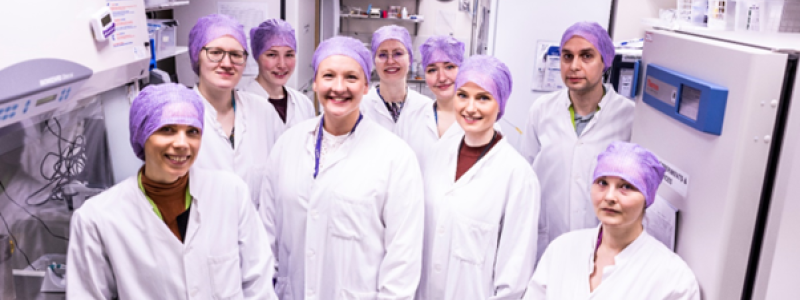
Tampere University and Tampere University of Applied Sciences create a unique environment for multidisciplinary, inspirational and high-impact research and education. Our universities community has its competitive edges in technology, health and society. www.tuni.fi/en
Job Description
Project title: Develop methods to assess the neuronal system (brain) state and the effect of the spatiotemporally steered stimulation on it for the control strategies of the spatiotemporal interference stimulation
Project tasks and objectives:
The BRAINET is an EU Horizon Europe – MSCA project where we aim to augment deep brain stimulation with electric field spatio-temporal interference stimulation. We aim to beneficially influence therapeutic regions deep in the brain without requiring deep electrodes. BRAINET sets out to develop skull implantable stimulation hubs forming a communication network for 3D targeting by self-organization, providing semantic information transfer and synchronization, and thus enabling self-adjusting therapeutic stimulation. The stimulation hubs will be powered by novel magneto-electrical transducer stacks, driven by slowly alternating magnetic fields from the outside and will perform adjustable frequency stimulation by novel nano-modified, compliant electrodes only touching the brain. Network formation will be enabled by multiphysics approaches and ionic in-body communication instantiated by dedicated microelectronic hardware. Preclinical in-vitro and in-vivo testing of devices and methods will allow real world validation of this unusual Brain-Computer Interface.
More information: (7) BRAINET: Overview | LinkedIn
The doctoral candidate at Tampere University will develop novel in-vitro neuronal cell culture environment to assess the non-invasive interference stimulation and the newly developed microdevice generation. It will be in the doctoral candidate’s hands to design, fabricate, and test the in-vitro setup possible enabling 3D or semi 3D cell culturing with interference stimulation system and e.g. commercial multielectrode array system. This position is suitable for technically gifted biologists, biologically oriented engineers or any scientist not afraid of interacting with living cells, 3D materials, electric stimulation and cellular electrophysiology recordings.
Planned secondment(s): Prof. Ulrich Hofman laboratory, University of Freiburg, Germany for in vivo preclinical studies for 3 months, Prof Barros lab to integrate the neuronal status assessment with multi-physical communication platform for another 3 months.
The Doctoral Candidate will also be involved in dissemination through social media promotion of the network, such as project website, LinkedIn groups, YouTube video channels, and blogging.
Place of employment: Tampere University, Finland
Supervisory team: Prof. Jari Hyttinen, Dr. Jarno Tanskanen, Dr. Annika Ahtiainen
Expected starting date: March 1st, 2026., or as mutually agreed between both parties.
Duration of the work contract: 36 months/full-time contract
Trial period: 6 months
Target degree: PhD degree from Tampere University, Finland
Approximate gross salary: In Finland about 3950€/month plus family allowance if applicable. The salary will be defined in accordance with MSCA funding rules.
Requirements
We are looking for a talented, creative and highly motivated researcher. Recruited researcher can be of any nationality. Doctoral Candidate must be eligible to be enrolled into Doctoral Program at Tampere University and have not been awarded a doctoral degree. The candidate must also comply with the respective employers’ requirements in Finland.
MSCA Mobility Rule: at the time of recruitment by the host organization the researcher must not have resided or carried out his/her main activity (work, studies, etc.) in the country of his/her employer (Tampere University, Finland) for more than 12 months in the 3 years immediately prior to his/her recruitment. Compulsory national service and/or short stays such as holidays and time spent as part of a procedure for obtaining refugee status under the Geneva Convention are not considered.
The applicant must be in possession of Master of Science (MSc) diploma Biomedical Engineering, or in Biology, Biotechnology with interest on neural engineering and in-vitro methods.
English language requirements: Proficiency in written/spoken English is mandatory. In certain cases, we may ask for a language certificate.
We offer
Please read more about working at Tampere University here.
Finland is among the most stable, free and safe countries in the world, based on prominent ratings by various agencies. It is also ranked as one of the top countries as far as social progress is concerned. Tampere is counted among the major academic hubs in the Nordic countries and offers a dynamic living environment. Tampere’s region is one of the most rapidly growing urban areas in Finland and home to a vibrant knowledge-intensive entrepreneurial community. The city is an industrial powerhouse that enjoys a rich cultural scene and a reputation as a center of Finland’s information society.
Faculty of Medicine and Health technology is a vibrant multidisciplinary faculty integrating biotechnology, biomedical Engineering and medicine with state of the art laboratories and facilities (Faculty of Medicine and Health Technology)
Prof. Hyttinen laboratory: Computational Biophysics and Imaging Group
For more information on Tampere and Finland, please visit:
How to apply
Please submit your application through our online recruitment system. The closing date for applications is 1st March 2026 at 23:59 Finnish time (EEST / UTC+2).
Please note that we do not accept applications submitted by e-mail. We only consider applications and documents submitted to the Laura recruitment system.
The applicant must submit the following documents through LAURA portal, only a clear copy of the documents will be considered.
- Certified copies of the bachelor’s and master’s degree certificates with the Diploma Supplement (DS) as approved by the EU Commission for degrees completed in European universities (when applicable) Official translations into English (if the original documents are in a language other than English)
- Curriculum Vitae/CV (preferably in Europass format)
- List of publications (if any) your contributions in the publication
- References: Contact details of 2 or more referees included in the CV
- Motivation letter: maximum 1 page where you introduce yourself and present your qualifications; you may include also your previous research fields and main research results. Please emphasize your future goals career-wise
Please note that we will begin conducting interviews during the application period, so early applications are encouraged. This allows us to get to know candidates as soon as possible and keep the process moving efficiently. Please apply at your earliest convenience!
For more information, please contact:
Professor Jari Hyttinen, jari.hyttinen@tuni.fi